
What to Look for in Strength Coaching Software (2026 Guide)
Every coaching platform on the market will tell you the same thing. They will say they make you more efficient, help you scale, and let you make more money. They show you a wall of features and a list of muscles the software can flex. What almost none of them tell you is how to actually use that feature set in a way that matches how you coach. They sell you the dream of scale. They do not connect it to the job.
If you found your way to this article, you are probably not chasing a dashboard full of buttons. You care about coaching. You care enough that you are trying to build real financial freedom out of it, and you know the only durable way to do that is to be excellent at the work itself. You are looking for software that helps you do a better job, not software that just looks impressive in a demo.
And there is a good chance you have not switched yet. You might still be on spreadsheets, or an older app you have outgrown, because you are afraid that moving your athletes to something new will give them a worse experience. You do not want to introduce friction and drag your clients into a tool you are not even sure is better. That fear is legitimate, and it is exactly why you have to evaluate software against the right criteria instead of the longest feature list.
The short version: the best strength coaching software does not just save you time. It saves you time on the commodity work, like writing progressions, and then gives you the tools to pour that reclaimed time into what your athletes actually value, which is your attention. Evaluate any platform on whether it solves for attention, makes your data usable, consolidates your tools into one place, uses AI to deploy your knowledge rather than replace it, and is built and maintained by people who understand the coaching you do.
What problem is the software actually solving?
Start here, because most coaches evaluate software backwards. They compare feature lists. The right question is what problem the tool solves, and whether it is the problem that actually matters.
Here is what we know from the data and from what the best coaches are doing. Athletes care, first and above almost everything else, about the attention you give them. Ask an athlete what they value most about your coaching and they will not say your set-and-rep schemes. They will say things like the attention you pay to detail, how well you coach them up, the cue you gave that they could implement on the very next rep. They describe the intangibles, the things outside the programming, because that is the art of coaching. You did not get into this to write progressions. You got into it because you care about people and you want to see athletes get results.
So the first principle is this: the software has to solve the right problem. Not just time saving in the abstract, but freeing up your time and then giving you the tools to redeploy it into delivering more attention. Time saved is worthless if it has nowhere valuable to go. A platform that makes data entry fast but makes real coaching harder has optimized the wrong half of your job.
Everything below is a test you can run against any platform you are considering, including ours.
Does it solve for attention?
This is the first and most important filter, because attention is what your athletes are paying for.
Look hard at the video tools, because video is how you deliver attention at a distance:
Can you do in-app video review, without leaving the platform?
Can the athlete upload a video directly to the specific set it belongs to?
Can you give feedback on that set by text, by recorded video, and by voice memo?
Does it have an annotation tool that lets you draw directly on the lifter's video?
These matter because of how attention is perceived. When an athlete gets a video or a voice memo from you, it feels personal. It feels like you actually watched, actually thought about them. A line of text feels less personal and, fairly or not, less valuable. There is research support for the instinct: an eye-tracking study comparing video-delivered feedback to identical text-delivered feedback found that people pay measurably more attention to the video version. The medium itself changes how much of your effort the athlete actually absorbs.
The annotation piece is its own multiplier. Drawing the bar path or the breakdown directly on the athlete's lift communicates a correction in seconds that would take a paragraph of text the athlete may not even read correctly.
Now the part most feature lists hide: friction. The video tools only matter if your athletes actually use them, and athletes use what is easy. If your platform forces the athlete to upload video through some separate channel, through Instagram, WhatsApp, or iMessage, you have added what we call app friction. Every extra step lowers the odds the athlete bothers. And here is where it costs you money: an athlete who is not using the feedback features you built your offer around starts to feel, consciously or not, like they are paying for something they do not fully use. That feeling is the first step toward a downgrade or a cancellation. Underused service is churned service.
So the test is simple. If your analysis of a platform shows you will need third-party tools bolted on just to deliver video feedback, that is a red flag. The friction will quietly cost you athletes.
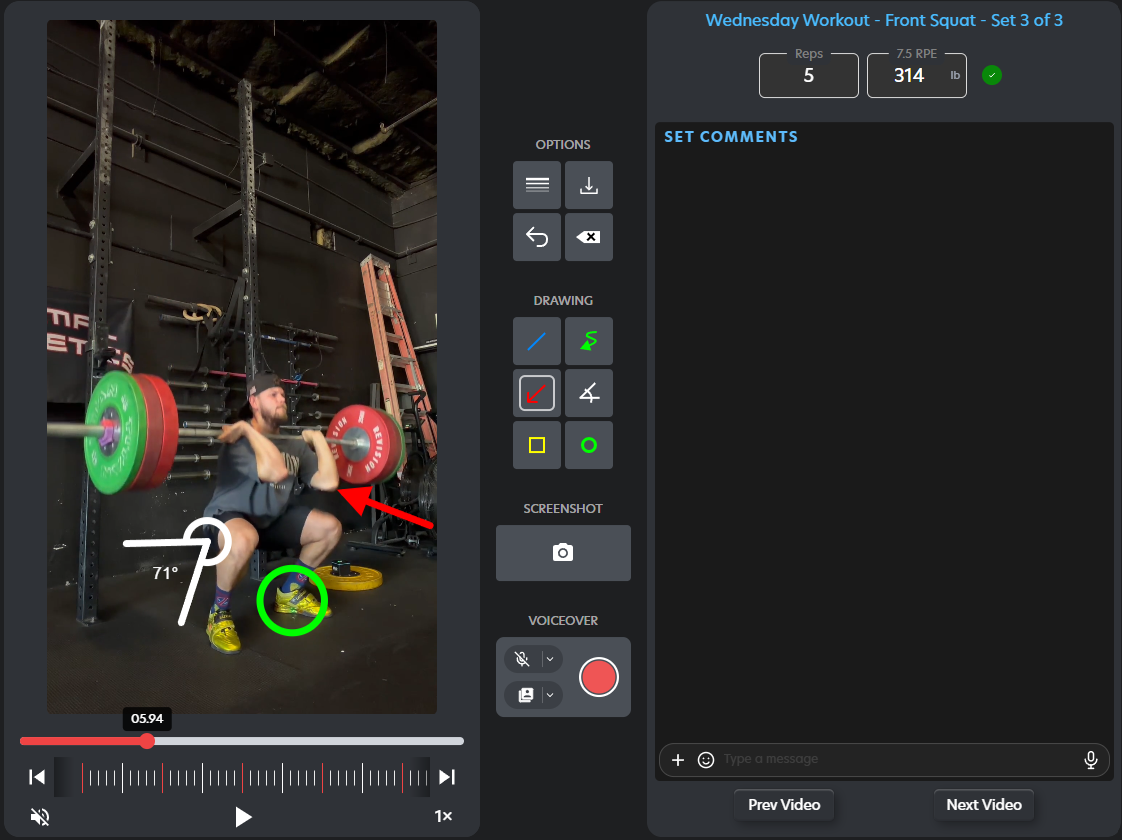
See in-app video annotation and set-level feedback in action.

Does the data actually become usable, or does it just get stored?
A lot of apps claim they track data. The claim is nearly meaningless on its own. What matters is whether they track the things you care about, and whether that data is easy to interpret and act on.
Coaches sit all over the spectrum. Some track everything, some track almost nothing, most are in the middle. The point is not to track more, it is to track what is relevant to the athlete in front of you and to be able to read it at a glance. Tonnage, intensity distribution, volume on a specific movement or movement group, progress on a key lift over months and years. The data has to answer the questions you actually ask as a coach.
And it has to be usable in two directions. First, easy for you to interpret and adjust. Inside CoachLogik, for example, you can save how analytics display based on the type of athlete. Your Olympic weightlifter's dashboard can show one set of graphs and metrics, while your general strength athlete's dashboard shows different charts built around the movements that matter for them. You are not forced into one generic view that fits no one.
Second, easy to show the athlete. This is the part coaches underrate. Being able to export the data, email it, or screen-share it and walk the athlete through their own progress is a retention tool, not just an admin feature. When you highlight the progress an athlete has made, in real numbers they can see, they stay longer. People quit when they cannot feel progress, even when the progress is real. Visible progress is sticky progress.
The cautionary pattern here is the platform that lets you write programs fast by typing into a text box, the equivalent of programming in a Word document, but gives the athlete nowhere to log that work into a tracked, graphable cell. Fast to write, impossible to analyze. Try to find what an athlete's PRs were two years ago in a system like that and you will understand the limitation immediately. Speed of entry means nothing if the progress disappears.
Can you run your whole coaching practice in one place?
The goal is one app for programming, communication, adjustments, and video analysis. One platform for both the individual athletes you coach one-to-one and any teams or groups you program for. The moment your practice is spread across multiple tools, you start paying a tax most coaches never put a number on.
That tax is real and it is measurable. A joint study by Qatalog and Cornell University found it takes about 9.5 minutes, on average, to get back into a productive workflow after switching to a different application. The cost is not the switch itself, it is the reorientation on the other side of it. Separate research from Harvard Business Review found knowledge workers toggle between apps and websites around 1,200 times a day and lose roughly four hours a week just reorienting, which works out to close to 9 percent of their working time over a year.
Now apply that to a coach running three different apps to manage teams and individual clients, which we hear about constantly. Every jump from your programming tool to your messaging app to your video tool to your spreadsheet is one of those switches, and the refocus cost stacks up all day. This is death by a thousand cuts. Each cut is small and nearly invisible, which is exactly why it is dangerous. Consolidating into a single platform is not about convenience. It is about reclaiming hours you can spend on coaching instead of on tool-juggling.
It also reduces friction for your athlete, who now has one place to train, log, upload, and hear from you, instead of a scavenger hunt across apps. Lower coach friction and lower athlete friction in the same move.
If a platform cannot handle both your individual and your team programming, or cannot cover programming, communication, and feedback without help, you will end up rebuilding the multi-app problem you were trying to escape.
Does the AI deploy your knowledge, or try to replace it?
AI is the most abused word in fitness software right now. Plenty of apps slap "AI" on the box. Some of it is genuinely useful. A lot of it is slop, generic output that is not focused on the actual job of coaching, or a thin wrapper that just hands you whatever a general chatbot would say with no real training architecture behind it.
You do not need to understand the engineering to evaluate this. You need to be honest about what you actually want the AI to do. And let's be real: you did not get into coaching so that an AI model could invent the workouts for you. If the tool is making up the training, it is doing your job, badly, and stripping out the exact thing your athletes pay you for.
The right role for AI is to supercharge your ability to program, so you spend your knowledge and your judgment instead of your hours. It should take what you already know and deploy it efficiently. You are not going to type a vague prompt and hope for a decent lower-body day for a general-population lifter. You know exactly what you want:
Three sets of squats
Three sets of leg press
Three sets of leg extension supersetted with hamstring curls
The job of a good AI tool is to build that out for you instantly, in your system, structured and tracked, the moment you express it. And then to take an instruction like "next week, same thing, add one RPE" or "add a set," and execute it across the program without you hand-editing every cell. That is AI as a modality for expressing your thought process at speed. It is not AI thinking for you. It is AI getting out of the way so your thinking reaches the athlete faster.
That distinction is the whole game, and it is what we build CoachLogik's AI coach around. You bring the knowledge and the intent. The tool handles the mechanical assembly. The art stays yours.
So the buyer's test: does the AI let you direct it with your own programming logic, or does it try to generate training out of thin air? The first is leverage. The second is a gimmick that will embarrass you in front of a serious athlete.
Who built it, and are they still building it?
The last filter is the one coaches almost never think about, and it might be the most predictive.
A lot of the platforms in this space have been around a long time. They got big, and then they got bought. Acquisition changes what a product is for. Once a platform belongs to a larger corporation, the pressure is to go broad, to chase the widest possible market and become a Swiss Army knife that serves every kind of trainer a little and no kind of trainer deeply. Depth gets sacrificed for reach.
So ask two questions about any platform. Who is it built for, and are they still building it. You want a tool whose makers are focused on the specific kind of coaching you actually do, and who are still actively developing it rather than maintaining an acquired asset.
This is where we are clear about CoachLogik. We are built for the serious strength coach, the coach who cares most about the results their athletes get. We support real coaches as they grow and serve whatever client avatars their business requires, but we are not going to become the general-population fitness-trainer app. That would cast a wider net, and we believe it is the wrong decision, because it would mean abandoning depth for the exact coaches we want to grow alongside. We would rather be masterful at real coaching than mediocre at everything. And we are founder-led and still building, every week, with no end in sight.
One honest note in the same spirit: we do not yet have native nutrition built in. It can be handled through templates as a workaround, and native nutrition is in active development. We would rather tell you that than pretend the box is checked, because the entire point of this article is evaluating software honestly.
Take the five tests to any platform you're considering.
Attention. Usable data. One consolidated practice. AI that deploys your knowledge. Builders who are still building.

The bottom line
Strength coaching software is not about who has the most features. It is about whether the tool solves the right problem: freeing your time and converting it into attention, the thing your athletes actually pay for.
Run the five tests on anything you consider. Does it solve for attention with real, low-friction video tools. Does it turn data into something you can read and show the athlete. Does it consolidate your practice into one place. Does its AI deploy your knowledge instead of replacing it. And is it built, and still being built, by people who understand the coaching you do.
We built CoachLogik to pass every one of those tests for the serious strength coach. If that is who you are, start a free trial and see what it feels like to run your coaching out of one platform that was built for the job.
Frequently asked questions
What should I look for in strength coaching software?
Five things: real, low-friction video feedback tools; data that's actually usable and easy to show an athlete, not just stored; one platform that covers programming, communication, and video instead of several stitched together; AI that deploys your own coaching logic rather than inventing workouts for you; and a team that's still actively building the product rather than maintaining an acquired asset.
Why does video feedback matter so much in coaching software?
Athletes pay you primarily for attention, and video is the highest-attention medium you can deliver remotely. Research on feedback delivery shows people engage more with video than with identical feedback in text. The best platforms let you record, annotate, and attach feedback to a specific set — in-app, with no third-party tools required.
Is it better to use one coaching app or several specialized tools?
One platform, if it can genuinely cover programming, communication, and video without gaps. Research on task-switching shows it takes people roughly 9.5 minutes to fully refocus after switching applications, and knowledge workers can lose close to 9% of a work week to context-switching. Coaches running three or four separate tools pay that tax dozens of times a day.
What should AI actually do inside coaching software?
It should execute your programming logic faster, not generate training on its own. A good AI coach takes what you already know — your progression scheme, your movement selection, your goals — and builds it out instantly in a structured, trackable format. If the AI is inventing the workout itself, it's doing your job for you, and usually not well.
Does it matter who owns the coaching software company?
Yes. Platforms owned by larger holding companies or private equity firms tend to broaden toward the largest possible market, which sacrifices depth for reach. A founder-led platform built by people who deeply understand the specific type of coaching you do is more likely to keep building the depth that serious coaches need.
About the author
Zack Bartell is the co-founder of CoachLogik. He scaled his gym to 500+ members and 350 coached athletes, with over 100 lifters coached online. He helps coaches grow their coaching businesses and build financial freedom through strength coaching.